“Distribution flex” or “non-network solutions” are older than you think
Authored by Dr Gabrielle KuiperWhen would you guess that distributed PV was first used to substitute for a network infrastructure upgrade?

While the last global energy crisis in the 1970s highlighted the potential of demand management to support supply shortfalls, I would have imagined it’s only since around 2010 that the cost of PV has fallen sufficiently to be investigated as an alternative to infrastructure spend by distribution network engineers.
A deep dive back in the IEEE archives showed how mistaken I was.
The 1970s energy crisis also spurred investment in solar cell development and it turns out that the first recorded consideration of the use of distributed PV systems to substitute for distribution network infrastructure was in the late 1980s by staff at PG&E in California. In a conference paper by James Eyer, Kay Firor and Daniel Shugar in 1988 titled ‘Utility–owned distributed photovoltaic systems’ these PG&E staff argued against the use of levelised cost of energy (LCOE) for distributed PV applications.[1],[2] They instead examined PG&E’s project cost method and the theoretical potential for PV to relieve thermal overload, reduce line losses and improve power quality.
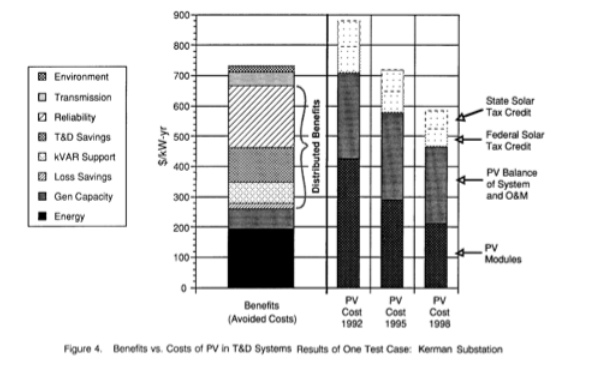
The first evaluation of the technical and economic potential of a specific project was a 1990 paper on ‘PV in the utility distribution system’ examining how the upgrade of a 10.5 MVA transformer in the Kerman substation could be delayed for five years by installing a distributed PV system.[3] This paper considered the avoided costs and distributed benefits illustrated in the graph below against the costs of a 500 kW PV plant to relieve thermal overload at the substation. The estimate showed that the PV system was marginally cheaper than upgrading the transformer bank, but only if solar tax credits were available, a 10% environmental adder is applied to avoided energy costs, and reliability was valued using customer value‑of‑service numbers.
Staff at PG&E went on to design a software tool that ‘not only quantifies the benefits of distributed PV but also optimally designs a PV plant with or without storage for utility distribution system support’.[4] The Kerman PV plant was completed as part of project PVUSA (Photovoltaics for Utility-Scale Applications) in June 1993, the first grid-support PV demonstration plant in the world.
This archival research taught me a few lessons. The first is that innovators at the right place and the right time with management support can be far ahead of the curve. The second is that unfortunately old economic regulation dies hard. Even though distribution solutions, including aggregated DER (also known as Virtual Power Plants or VPPs) have been able to provide cheaper alternatives to capital expenditure since the 1990s, only one jurisdiction in the world has implemented this at scale—and it’s not the United States or even California. Great Britain set about overhauling the economic regulation of its networks in 2010. The result prioritised distribution flexibility on at least a level playing field with expensive capital expenditure in the RIIO (Revenue = Incentives + Innovation + Outputs) revenue regulation introduced by Ofgem for distribution in 2015. Ofgem subsequently promoted a ‘flexibility first’ approach in RIIO-ED2. The figures for 2024-25 showed 9GW of flex procured across Britain’s distribution networks and the 2025-26 figures can be expected to top over 12GW procured from large and small businesses, water utilities and households. In 2017, the Carbon Trust together with Imperial College London estimated additional flexibility could create whole-energy-system savings up to £40bn by 2050.
The technology is proven, the economic savings are clear, we just need energy market regulators to create the conditions to enable distributed energy resources to substitute for infrastructure expenditure at scale, as was first proposed in California in the late 1980s and demonstrated at the Kerman substation in 1993.
The use of distributed PV to provide non-network solutions has its origins in 1980s California
References[1] Eyer, J. M., Firor, K., & Shugar, D. S. (1988). Utility-owned distributed photovoltaics systems. In Proceedings of the 20th IEEE Photovoltaic Specialists Conference (pp. 1051–1055). IEEE.
[2] James M. (“Jim”) Eyer, Kay Firor and Daniel S. (“Dan”) Shugar each continued significant US solar and distributed-energy careers after PG&E. Eyer later analysed the value of distributed generation and storage for network deferral; Firor founded Blue Mountain Energy, later Blue Mountain Solar, and remains involved in the business; and Shugar held senior solar-industry roles before founding and becoming chief executive of Nextpower (formerly Nextracker).
[3] D. S. Shugar, Photovoltaics in the utility distribution system: The evaluation of system and distributed benefits, IEEE Conference on Photovoltaic Specialists, Kissimmee, FL, USA, 1990, pp. 836-843 vol.2, doi: 10.1109/PVSC.1990.111739
[4] Jennings, C., Wenger, H., Iannucci, J., Shugar, D., Hester, S., Candelario, T., Ball, G., Reading, M., Whitaker, C., Hoff, T., Candelario, R., Heinzmann, J. D., Townsend, T., & Hutchinson, P. (1991). Photovoltaic research at Pacific Gas and Electric Company. In Proceedings of the 22nd IEEE Photovoltaic Specialists Conference (pp. 593–599). IEEE.