perovskites could change the world
Interview with Dr Xiaojing Hao, University of New South Wales
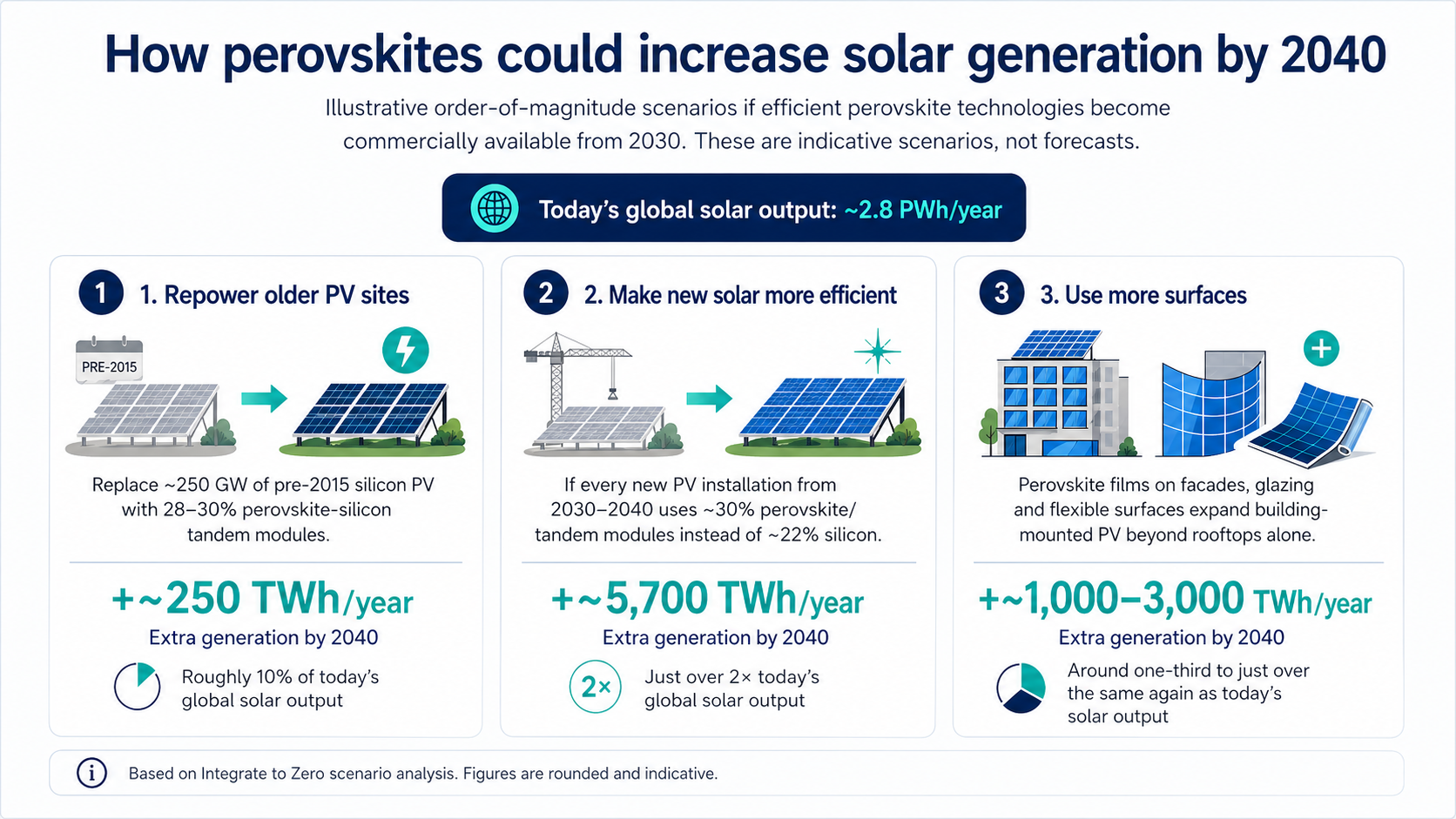
If commercially available by 2030, efficient, flexible perovskite solar panels could plausibly deliver additional generation of up to around twice today’s ~2.8 PWh of global solar output by 2040, compared with a business‑as‑usual silicon pathway – by repowering pre‑2015 PV, making every new module more efficient, and coating our walls and windows.
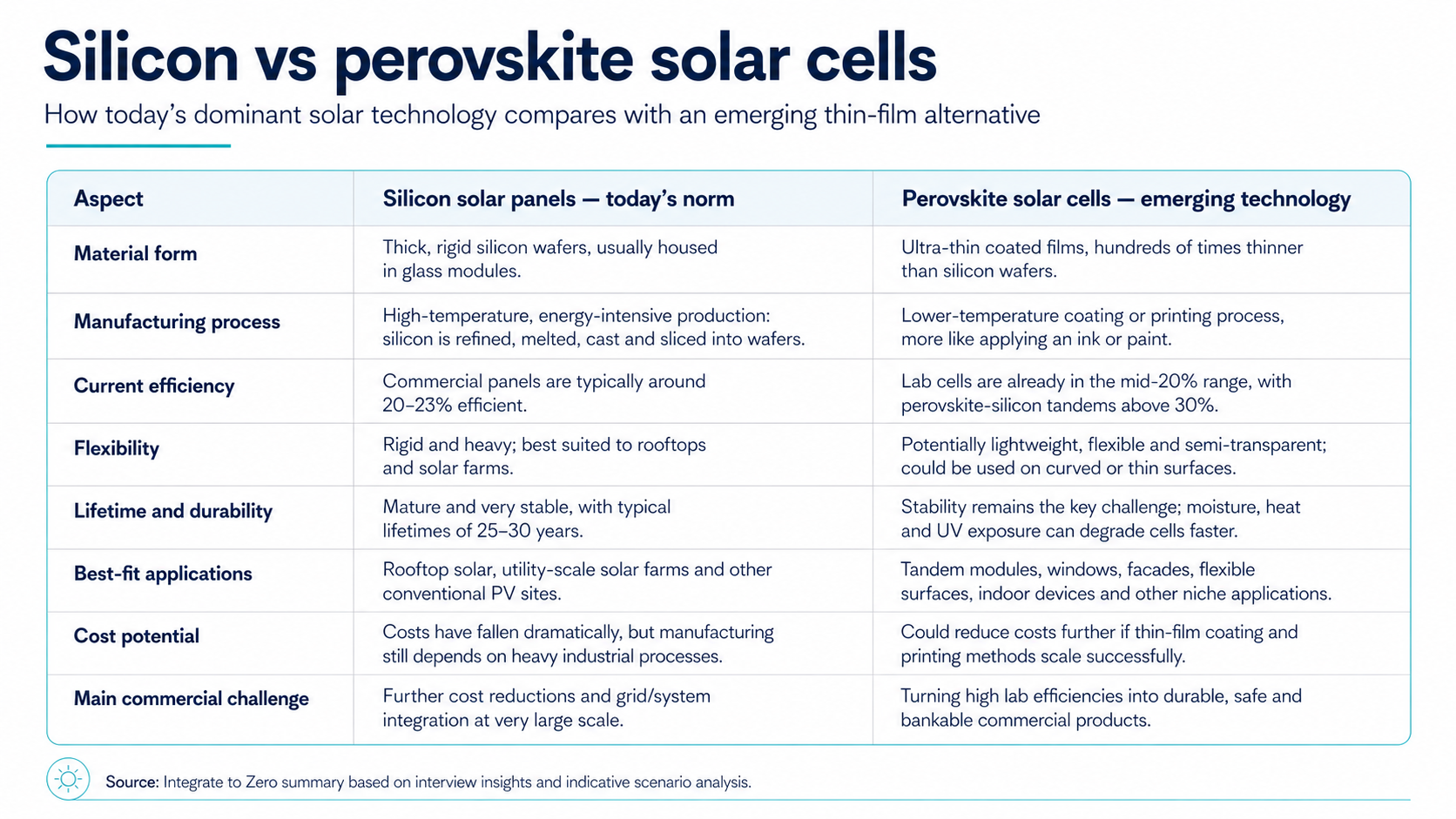
If you know about solar cells, you probably know they are usually made from silicon. You may not know that silicon must be mined from quartz‑rich sand and melted into blocks, which are then sliced into crystalline wafers that form the core of a rigid solar module.
Over the past decade, researchers have been developing a different kind of solar cell using a crystal structure that mimics the natural mineral perovskite. Instead of thick silicon wafers, perovskite cells are made by dissolving materials into a liquid and coating them as an ultra-thin film onto a surface — more like ink or paint, and hundreds of times thinner than a silicon wafer.

Professor Xiaojing Hao, University of New South Wales and Dr Gabrielle Kuiper, Integrate to Zero
Scientia Professor Xiaojing Hao at the University of New South Wales has helped push this technology to the frontier. Together with Professor Jun Peng at Soochow University, her team holds the world-record for perovskite solar cell efficiency of 27.3% on a tiny lab-made cell.
I had the delight of interviewing Professor Hao about the opportunities and challenges of perovskite technology, and what it might mean for the future of electricity generation.
There are a number of competing types of solar technology. What prompted you to focus on perovskite?
Perovskite is “a very good material for reaching high efficiency relatively easily,” Professor Hao explains. “Even undergraduate students can be trained to make devices with efficiencies of about 25%, which is very motivating.”
“It [also] has low-cost manufacturing potential because it can be processed from solution,” she says, creating flexible solar cells.
How hard will it be to get from record efficiencies in the lab to, say, equally high commercial efficiencies?
Professor Hao says that scaling up perovskite cells is “both a scientific question and an engineering question.” The major issue for perovskites today is stability which is a science question: making sure devices do not degrade in real‑world conditions, particularly when exposed to light (UV), heat and electrical bias stress. “Our focus is increasingly on stability while maintaining high efficiency,” Professor Hao says. “We are actually looking at each layer that has its inherent stability issues, and designing strategies to mitigate the problems we have already identified — while recognising there may still be others we have not identified yet.”
What are the fundamental breakthroughs needed?
Professor Hao says that “stability is the key issue for commercialisation.” However, different deployment scenarios shift this constraint. In utility-scale solar farms, the benchmark is silicon: “we expect silicon to last 20 to 30 years, so any new solar cell technology — or a silicon tandem using a top cell — needs to meet that expectation. For that application, durability, high efficiency, and dollars per watt are the key things we have to consider.”
She went on to say, “But in some niche markets, such as building facades or solar windows, people may accept a much shorter lifetime — for example five to ten years. In those cases we also have to consider another issue: toxicity. High-performance perovskites contain lead, and if the material is exposed to water it can dissolve, so if we use it in applications close to people we need to manage that risk carefully including end-of-life management.”
At the moment, there are only very small applications of perovskite, for example replacing batteries in remote controls or other small appliances. Where do you see the main applications being in the future?
Professor Hao’s answer starts with windows: “You print your solar cells on the sticker and then stick it onto the glass. The reason that works is that glass is already a construction material, so the solar layer can simply be added there. Even if it is slightly degraded, you can replace it and put on another one. In the future, you could even have different coloured window stickers as well.”
These emerging inorganic window coatings are already at certified efficiencies of 10.7% in small size, with plenty of headroom. For perovskite, the efficiency is much higher, however, non-toxic lead-free perovskites suit better as it is close to people.
“If it is inside the window, it can capture light from outside and also some light from inside,” she explains. “The indoor light is much weaker than sunlight, but it can still be converted into electricity. So the idea is that an indoor device can capture light during the day from the sun and from inside lighting, and at night it can still power some devices.”
“It could be especially useful for apartment buildings and offices, where we have more window surfaces and it is harder to install conventional solar cells” she notes, and the glass is already there, so you can just retrofit the windows. “It’s also very helpful for resilience during power outages.”
On solar farms and rooftop solar systems, the bigger prize is tandem modules — pairing perovskite with silicon to increase power per square metre. “If you can replace (outdated) silicon with a higher-efficiency tandem module, you get more power generation per unit area,” she says.
Do you think we’ll have perovskites embedded into our cars?
“That’s possible,” Hao says. “For the car you’re going to have vibration; you have to make sure they are mechanically strong. Cars see much wider temperature swings than rooftop PV.” she notes. “When we put it in a different scenario, there are always real application requirements.” So embedding solar cells into cars is not science fiction, but it needs rigorous stability and reliability considerations to be addressed.
As to how fast we can get to commercially viable perovskite, Hao’s message is one of grit and persistence. She describes global solar-cell efficiency progress as a series of plateaus and jumps. “Every 5% efficiency milestone needs a lot of work,” she says. But the targets are commercial efficiencies of 30% then 35% and eventually 40%. That would be roughly double the efficiency of current modules.
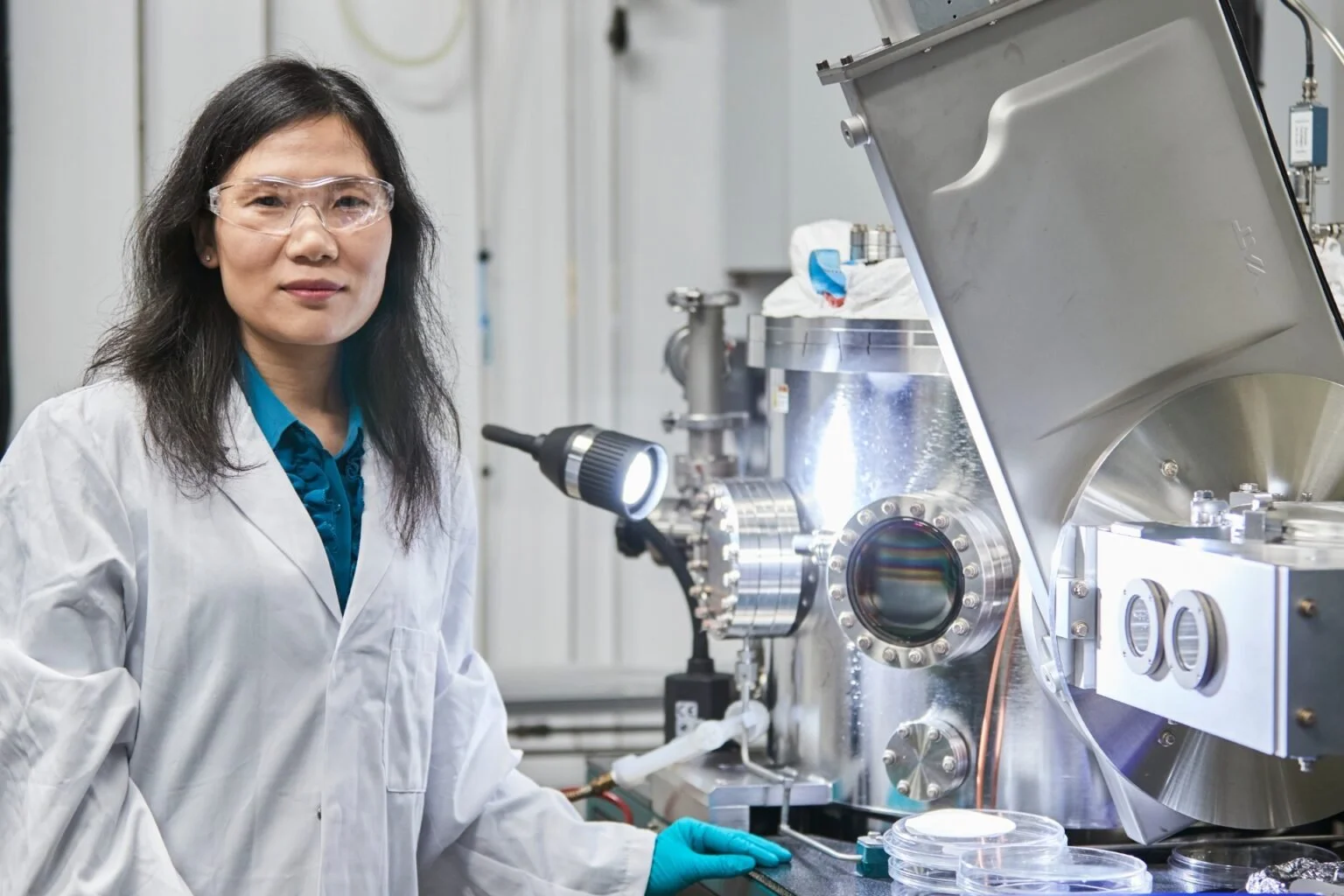
“When we have higher efficiency and more power from the same area… that’s definitely going to change the world”
To put the possibilities of perovskite in context, Integrate to Zero crunched some rough scenario numbers on how much commercially available perovskites might change indicative solar generation by 2040:
Repowering the 250 GW of pre-2015 silicon PV globally with 28-30% perovskite-silicon tandem cells by 2040 could boost output from those sites by roughly 75%, adding ~0.2 TW of effective capacity and about 250 TWh per year - around 10% of today's 2.8 PWh of global solar generation.
Making every new PV installation from 2030 to 2040 a ~30% perovskite/tandem module instead of ~22% silicon could deliver about 36% more power per square metre of new PV, yielding roughly 5,700 TWh per year of extra generation by 2040 - just over 2x today's global solar output and equivalent to building another 4.3 TW of conventional silicon PV on top.
Using perovskite films on facades, glazing and flexible surfaces could expand building-mounted PV potential by around 50-100% beyond rooftops alone, adding roughly 1-3 TW of capacity and 1,000-3,000 TWh per year of generation by 2040 - from about one third up to just over the same again as today's 2.8 PWh of solar.
These are deliberately simple, order‑of‑magnitude scenarios, not forecasts, but they give a sense of how big the prize could be if perovskites move from lab records into mainstream hardware anytime soon.