Flexing for the future: A global flexibility standard for appliances
Dr Gabrielle Kuiper and Dan Hamza-Goodacre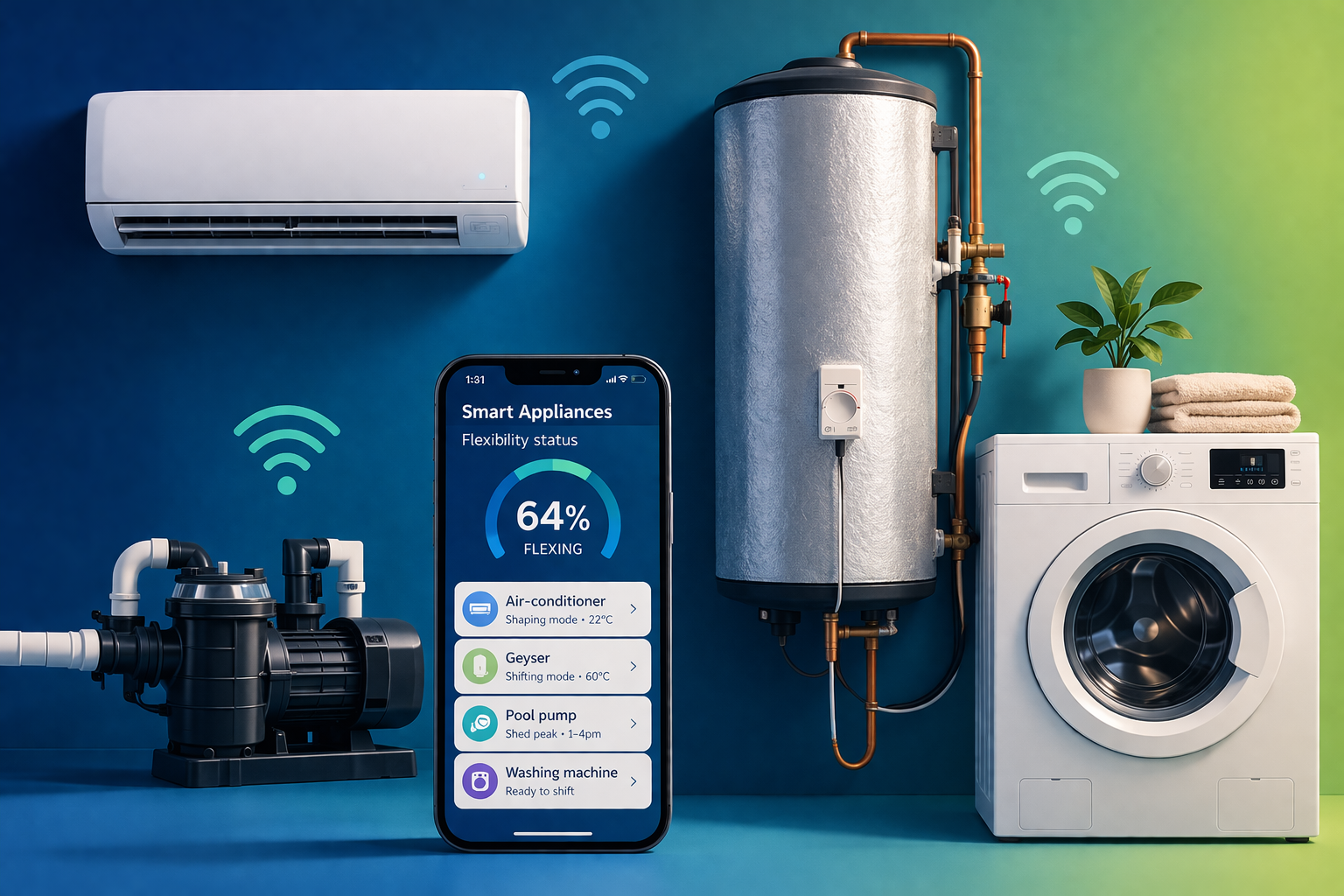
In the world of energy, flexibility is the ability to shift (in time) and/or modulate (increase or decrease) electricity consumption and/or production in response to an external signal, whether price, grid or a direct dispatch instruction from an aggregator or system or market operator. Flexibility has been seen as an optional efficiency tool, but is increasingly becoming an essential grid and system management solution for the energy transition.
Household appliances represent massive latent flexibility: residential electric heat pumps and air-conditioners can pre-heat or cool before peak periods; electric water heaters and household washers and dryers can shift loads to match midday solar generation or to fill overnight troughs. When aggregated, even programmable thermostats can deliver large capacity reductions.
More work is needed to calculate appliance flexibility, but overall estimates for flexibility suggest a huge opportunity. In the US, demand flexibility could cut peaks by about 200 GW (~ 20% of demand) by 2030, saving 10–18 billion dollars a year. EU‑27 modelling suggests buildings, EVs and industry could provide upward and downward flexibility equal to about 22% and 17% of peak demand (752 GW) in 2030. In Great Britain, planned growth in flexibility to 51–66 GW by 2030 is expected to reduce system costs by £30–70 billion through 2050, with existing flexibility procurements already saving billpayers hundreds of millions annually.
Despite the huge potential for residential flexibility, to date no common global appliance flexibility standard has been established that would guarantee performance. Appliance standards create consumer and retailer confidence and drive manufacturing and sales of higher quality products. More specifically, the lack of an appliance flexibility standard is creating uncertainty about communication between flexibility controllers and appliances, and a lack of visibility about flexibility quantum and market value.
Standards connectivity work to unlock residential appliance flexibility has been occurring for some decades with several communication protocols developed. More promising is the emergence of Matter, an open-source Internet of Things communication protocol being adopted by several major appliance manufacturers. Recent Matter versions 1.4 and 1.5 released in late 2024 and 2025 incorporate energy demand and price signaling respectively.
Improved confidence from standardisation can support aggregation to scale, unlocking benefits for the grid system as a whole, decarbonisation, consumer value and industry profitability.
As a first step, work needs to be done to agree on definitions. At a minimum appliance flexibility refers to what an appliance can do in response to instructions: shaping, shifting, shedding or shimmying power demand.

Household appliance flexibility requirements are emerging in certain jurisdictions. Great Britain's (GB’s) draft Energy Saving Appliances (ESA) regulations are world-leading but complex, establishing phased requirements for electric heating appliances, battery storage and EV charging from 2028, with projected system savings of £40–50 billion through 2050. Germany has mandatory appliance flexibility requirements, obliging new residential loads over 4.2 kW (heat pumps, EV chargers and storage heaters) to be remotely throttleable by grid operators during network risks, in return for reduced grid connection fees. This requirement is new and so the costs and benefits have yet to be assessed in practice. A handful of US states have pioneered mandating Flexible Demand Appliance Standards (FDAS) for water heaters to enable consumer bill savings with time-of-use tariffs. California has introduced a mandatory FDAS starting with pool pump controllers, requiring from 29 September 2025 that all units sold in the state be internet-connected with default operation aligned to daytime solar production.
Drawing on these best practices from across the world, we have drafted a set of common requirements for flexible demand from residential appliances. This function based ‘standard’ focuses on non‑EV household appliances – heat pumps and air-conditioners, electric and heat‑pump water heaters, pool pumps and other smart loads – and is deliberately protocol‑agnostic.
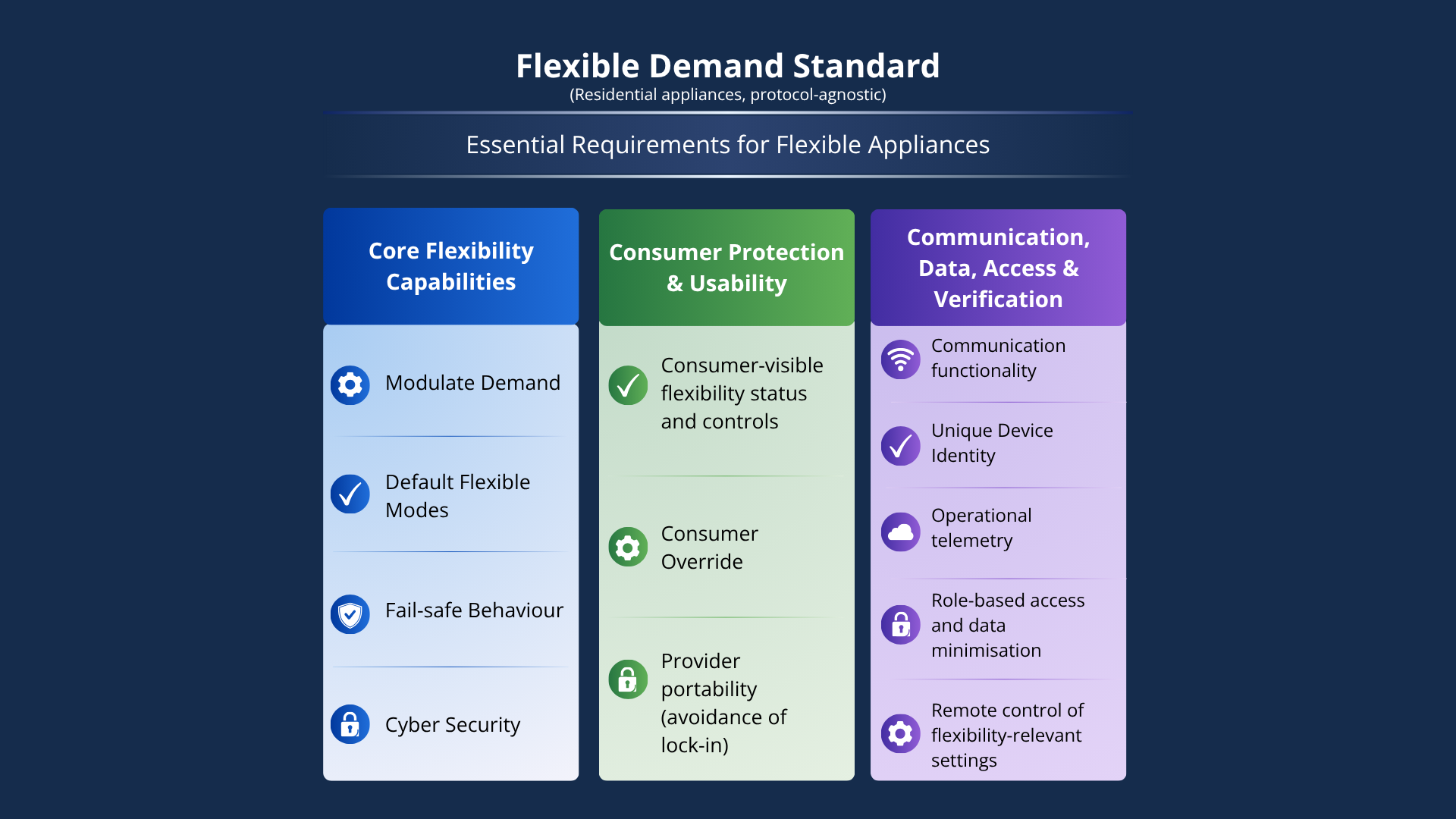
The standard has 12 flexibility requirements across three areas:
Core flexibility capabilities (could be in the device and/or software)
Modulate demand (including turning off or on) in response to external signals
Default flexible operating modes
Fail‑safe behaviour on loss of control or communications
Cyber security
Consumer protection and usability
Consumer‑visible flexibility status and controls
Consumer override
Provider portability (avoidance of lock‑in)
Communication, data, access and verification
Communication functionality (e.g. WIFI, Bluetooth, wired ethernet, etc)
Unique device identity
Operational telemetry for verification and diagnostics
Role‑based access and data minimisation
Remote read/update of flexibility‑relevant settings (machine interface)
Taken together these requirements would help create guarantees for both parties – the appliance owner (consumer) and the flexibility operator (e.g. utility, aggregator, VPP operator). To make standards a reality we recommend policy makers follow this a practical pathway:
Start with high‑power devices, then broaden if needed. Begin with heat pumps, water heaters and pool pumps (where numerous), where load‑shifting value is highest, then extend mandatory standards to white goods and smaller loads over time.
Move from voluntary to mandatory, including on interoperability. Voluntary schemes and codes are easier to agree and provide a chance to test drive the standard however they typically deliver only incremental change
Develop robust compliance regimes. Put in place clear test methods, conformity assessment, market surveillance and enforcement powers so non‑compliant devices (or software – see below) can be corrected or withdrawn.
Link standards to flexibility ‘markets’ (including for distribution) or incentive programs. Pair flexibility requirements with market rules or utility programs that let consumers and aggregators earn value from appliance flexibility, so capabilities are actually used.
In taking forward such a standard we see a big question to explore: what functionality should be standard in appliances (as has been the practice with energy efficiency standards – MEPS), what (if anything) should be required in software that is used to control the individual appliance and what (if anything) should be in Home Energy Management Software (HEMS) operating across one or more appliances in a home?
Core to these considerations is requiring open, interoperable communication protocols so that appliances and energy management systems can speak a common language. This avoids consumers being locked into vendors, and the resultant fragmentation seen in today’s smart‑device ecosystems. Both the Mercury Consortium and the Connectivity Standards Alliance (CSA) are industry‑led collaborations built around the principle of open, interoperable standards. The Mercury Consortium is focused on enabling interoperability for flexible, grid‑connected energy devices, supporting integration with energy markets and grid systems. In contrast, the CSA—best known for developing the Matter and Zigbee standards—concentrates on device‑to‑device connectivity, allowing smart home and connected products to communicate securely and reliably across manufacturers and ecosystems.
Recognised connected‑device security standards should also be non‑negotiable elements of any flexibility standard. For example, Great Britain is adopting the international cybersecurity standard ETSI EN 303 645.
If jurisdictions align around a set of common requirements, i.e. a global standard, they will make it easier and reduce costs for manufacturers to develop flexible appliances, for flexibility providers to operate profitably and for households everywhere to participate in flexibility programmes and markets.
It’s time for a global flexibility standard for appliances.